

The initial electrospinning concept works, but how do you turn it into an actionable product?
During feasibility, the question is relatively narrow: Can the selected material be electrospun into a usable fiber, coating, membrane, or device geometry? Once the answer is yes, the project enters a more demanding stage. The focus shifts from showing that the concept can be made to defining exactly what the material needs to become.
This is where optimization begins. Exploratory trials give way to an iterative development program built around product specifications, device requirements, analytical testing, and feedback from real samples. Fiber diameter, mat thickness, polymer formulation, and device geometry can no longer be considered independently. They must be refined together until the material can be meaningfully evaluated in its intended application.
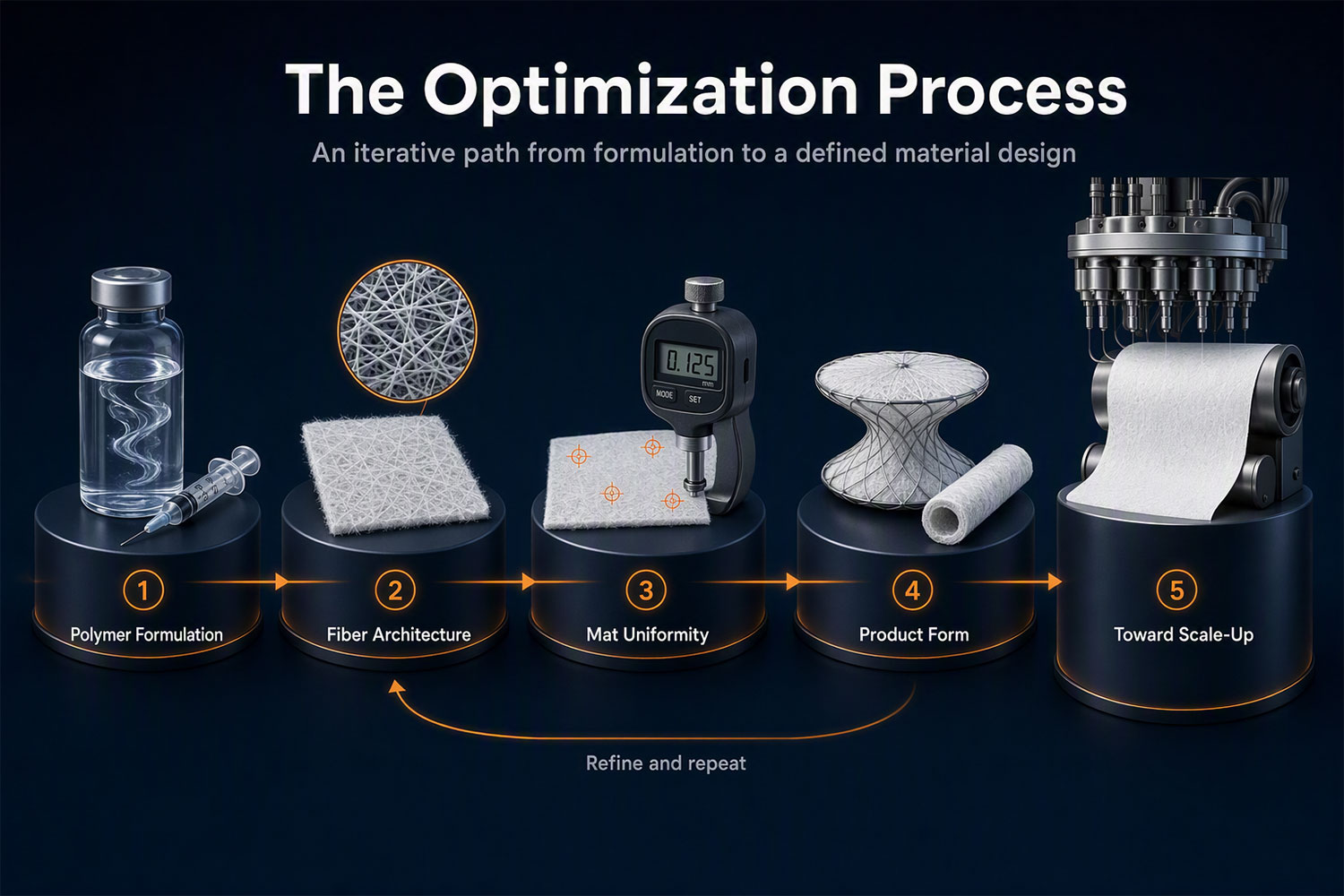
Throughout this article, we will follow that development process as the proof of concept progresses toward a defined material design:
- Optimizing the polymer formulation and processing conditions
- Refining fiber diameter, mat thickness, and material uniformity
- Tuning product geometry and developing collection tooling
- Producing iterative samples for testing and evaluation
- Establishing a material and process direction for scale-up
Together, these stages form the bridge between a concept that works and an electrospun material that can move toward scale-up and commercialization.
Refining the Polymer Formulation
Every electrospun material begins with the polymer. Before considering how well it spins, the polymer must provide the mechanical behavior, flexibility, durability, degradation profile, chemical resistance, or biocompatibility required by the application. Electrospinning can transform that polymer into a highly tunable fiber architecture, but it does not replace its fundamental material properties.
Once the polymer has been selected, the next task is persuading it to form the right fiber.
Sometimes the first part is easy. A polymer is dissolved, a stable jet forms, and fibers appear on the collector. That is an encouraging result, but it only shows that the formulation can be electrospun. The fibers may still be too large, too small, beaded, wet, or inconsistent. The solution may also spin well for a few minutes but become unstable long before enough material has accumulated to make a representative sample.
This is where solution screening becomes critical. Instead of preparing a complete mat from every possible formulation, short electrospinning trials are used to explore the design space quickly. Small changes in polymer concentration, solvent composition, and process conditions reveal which formulations are moving toward the target fiber diameter and which are unlikely to provide the required stability.
Solution concentration is one of the strongest levers in this process. It changes viscosity and polymer-chain entanglement, influencing whether the solution forms beads, continuous fibers, or a diameter outside the desired range. The solvent system adds another layer of control. A single solvent or combination of solvents must dissolve the polymer while providing the right balance of evaporation rate, conductivity, and surface tension. If that balance is wrong, the result may be wet fibers, needle buildup, clogging, or an intermittent jet.
Each short trial provides another piece of the formulation story. Promising conditions are adjusted, compared, and screened again until the target fiber begins to emerge consistently. Those formulations then advance to longer spins, where a new question must be answered: can the solution maintain that performance long enough to build the required mat?
A formulation that looks excellent during a short trial may change as it sits, accumulate at the needle tip, clog intermittently, or produce increasingly variable fibers over time. These problems become more consequential as the process expands. A temperamental formulation may be manageable at one needle and increasingly difficult at five. At 100 needles, the same instability can become interrupted jets, uneven deposition, material loss, and inconsistent product across the collector.
Optimization is therefore not complete when a formulation produces one good sample. The formulation must connect the polymer’s required material properties with the target fiber architecture and a stable electrospinning process. Through rapid screening followed by progressively longer trials, the concentration, solvent system, and operating window are refined until the formulation can reliably support sample production and provide a strong foundation for scale-up.
Balancing Fiber Diameter, Mat Thickness, and Preparation Time
An electrospun fiber mat offers an enormous amount of design freedom. Its architecture can be tuned to influence filtration, fluid transport, cellular response, mechanical behavior, drug release, and many other product functions. The challenge is turning that versatility into the right material for a specific application.
That process begins with the function. What must pass through the mat, and what must it retain? Does the material need high surface area, an open structure, mechanical integrity, or sufficient durability for handling? Those requirements are translated into measurable targets for fiber diameter, mat thickness, and basis weight.
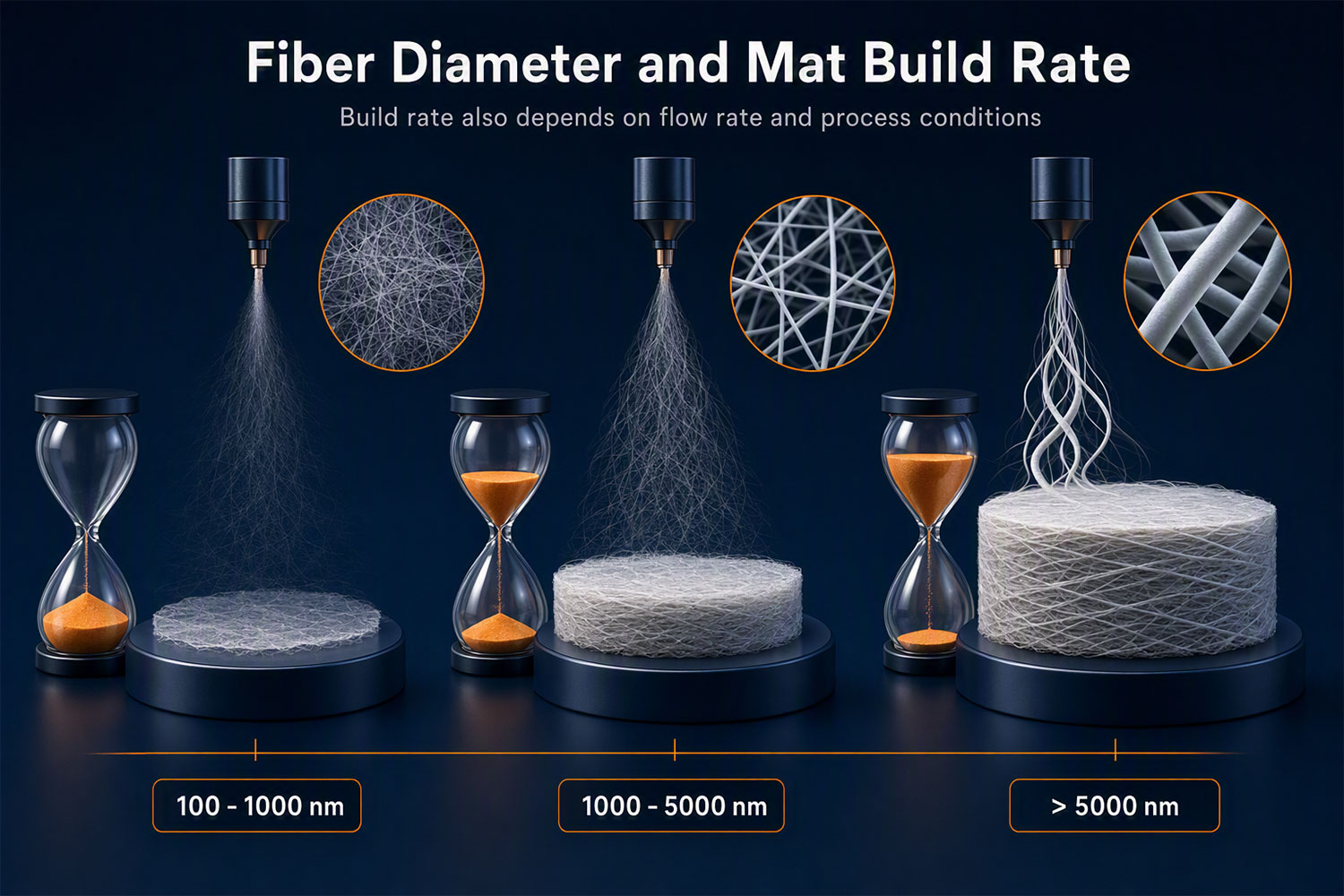
Fiber diameter establishes much of the mat’s underlying architecture. Depending on the polymer and formulation, electrospinning can produce fibers ranging from approximately 100 nm to 25 µm. Fine fibers can increase surface area and create smaller pores, while coarser fibers can produce a more open structure and improve handling. The goal is not to make the smallest fiber possible, but to identify the diameter that supports the intended function.
Reaching that diameter is an iterative process. Not every polymer or formulation can access the full range, and changing the solution concentration, flow rate, working distance, or applied voltage can shift both fiber size and morphology. Short trials and fiber analysis show how the material responds, allowing each adjustment to guide the next.
Once the target fiber begins to take shape, another part of the story emerges: the mat itself must build to a useful thickness. Fiber diameter, mat thickness, and preparation time move together. Coarser fibers generally build thickness more quickly, while very fine fibers may require substantially longer deposition times to produce a mat that can be removed, handled, and evaluated. A fiber that performs well may therefore require a different collection strategy or more time to become a practical sample.
Electrospun mats can be produced as thin as approximately 20 µm, but a free-standing mat at that thickness is often fragile and difficult to handle. Fiber diameter also creates a physical limit. A mat made from 20 µm fibers cannot have the same thin, film-like structure as one made from submicron fibers. Most electrospun mats fall within a practical thickness range of approximately 100 µm to 1 mm, although thinner coatings and thicker constructs can be developed when the application requires them.
Tuning the Product Form Factor
The desired fibers are forming, the formulation is stable, and a small mat has reached the target thickness. The material works on the collector, but it still has to take the shape of the product.
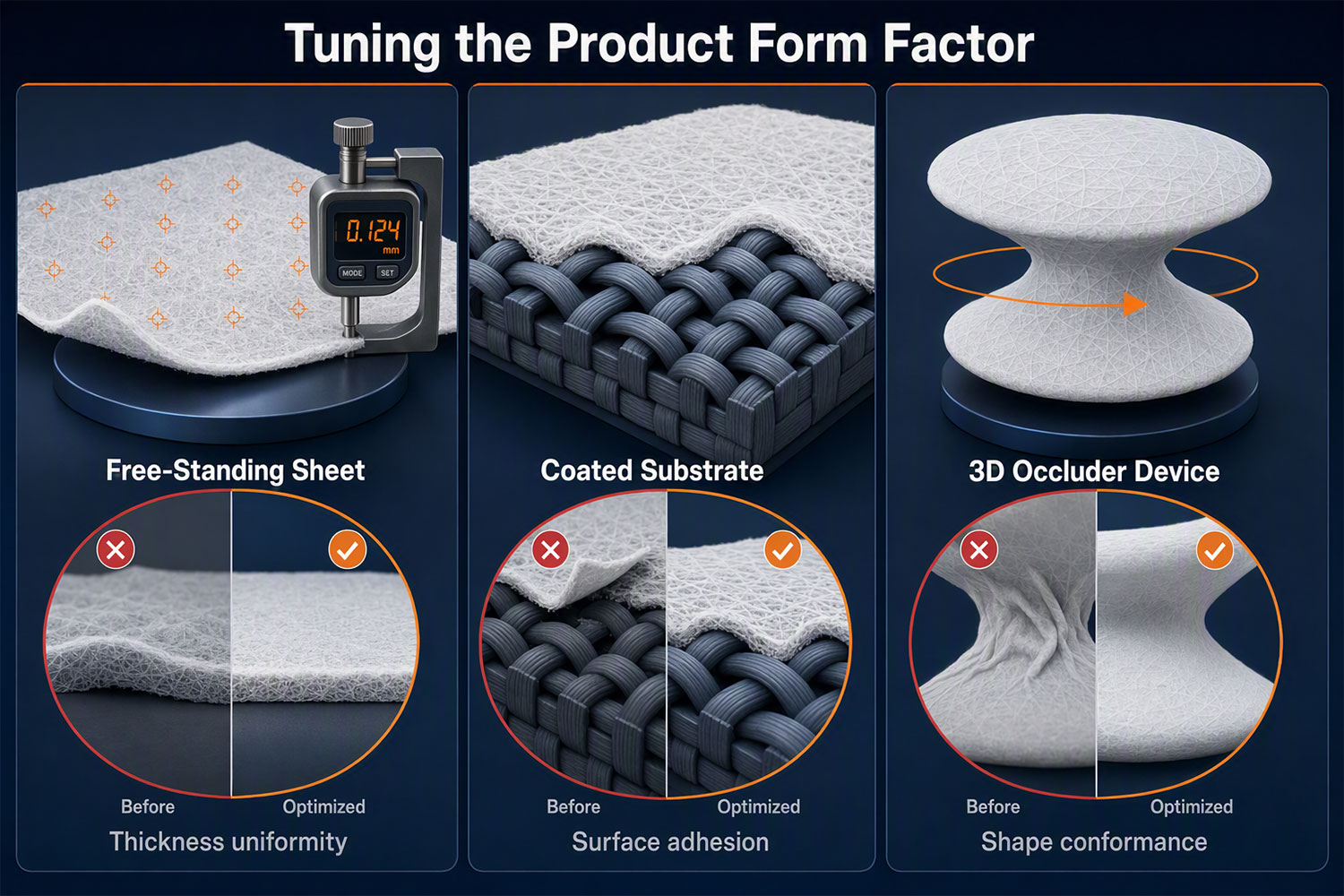
That may mean expanding a small test mat into a free-standing sheet, applying the fibers to a supporting substrate, or wrapping them around a complex three-dimensional device. In each case, the challenge is no longer only making the right fiber. It is placing that fiber consistently where it needs to go.
A single needle produces a relatively localized fiber stream. As the target area expands, the needle must translate across the collector to distribute the material. Translation speed, travel distance, working distance, voltage, and collector design begin to shape the dimensions and uniformity of the finished mat. A negatively biased collector can provide another lever by drawing more of the fibers toward the intended surface.
The need for this control becomes obvious when deposition is not well contained. Instead of building evenly on the collector, fibers may drift through the chamber and form webs across surrounding surfaces. Valuable polymer is consumed, preparation time increases, and only part of the resulting mat may be usable. Short trials reveal where the fibers are actually collecting, allowing the translation pattern, electric field, and tooling to be refined before a full sample is produced.
As the deposition becomes better controlled, the focus shifts from overall coverage to consistency. A sheet may reach its target dimensions and average thickness while still containing meaningful variation from one area to another. Thickness and basis-weight measurements across the mat show whether the selected fiber architecture is being reproduced throughout the usable area.
That consistency can be essential to product function. If a larger mat containing an active ingredient will be cut into individual units, uneven deposition may create differences in the amount of polymer and potentially the amount of active delivered by each unit. The process must therefore produce more than an acceptable average. It must place the material evenly enough for each portion of the mat to represent the intended product.
Depositing fibers onto another material introduces the next question: will the two layers remain together? An electrospun coating may look uniform on a substrate but separate during cutting, handling, assembly, or use. Adhesion must therefore be developed as part of the construct, often through iterations involving wet deposition, tie layers, controlled solvent wetting, or other interfacial strategies. Each adjustment must improve integration without compromising fiber morphology or the function of the underlying substrate. A filtration membrane, for example, gains little from a high-performing nanofiber layer if that layer separates from its support.
A three-dimensional device takes the same challenge into a more complex geometry. Fibers follow the electric field rather than simply tracing the surface below them. They may build on exposed edges, miss recessed areas, or bridge across openings that must remain clear. Rotation and translation can expose different surfaces to the fiber stream, while custom tooling, grounding, field control, and masking help direct deposition around unusual shapes.
Each trial brings the material closer to the intended form: first placing the fibers in the right area, then improving uniformity, establishing adhesion, and refining conformance around the device. Throughout that progression, the target fiber diameter, and thickness remain the guideposts.
Iterative Sample Development and Evaluation
Iterative sample development is where the critical design features begin to coalesce. Fiber diameter, mat thickness, polymer formulation, and product form can each be optimized individually, but they ultimately must work together in a complete testable sample.
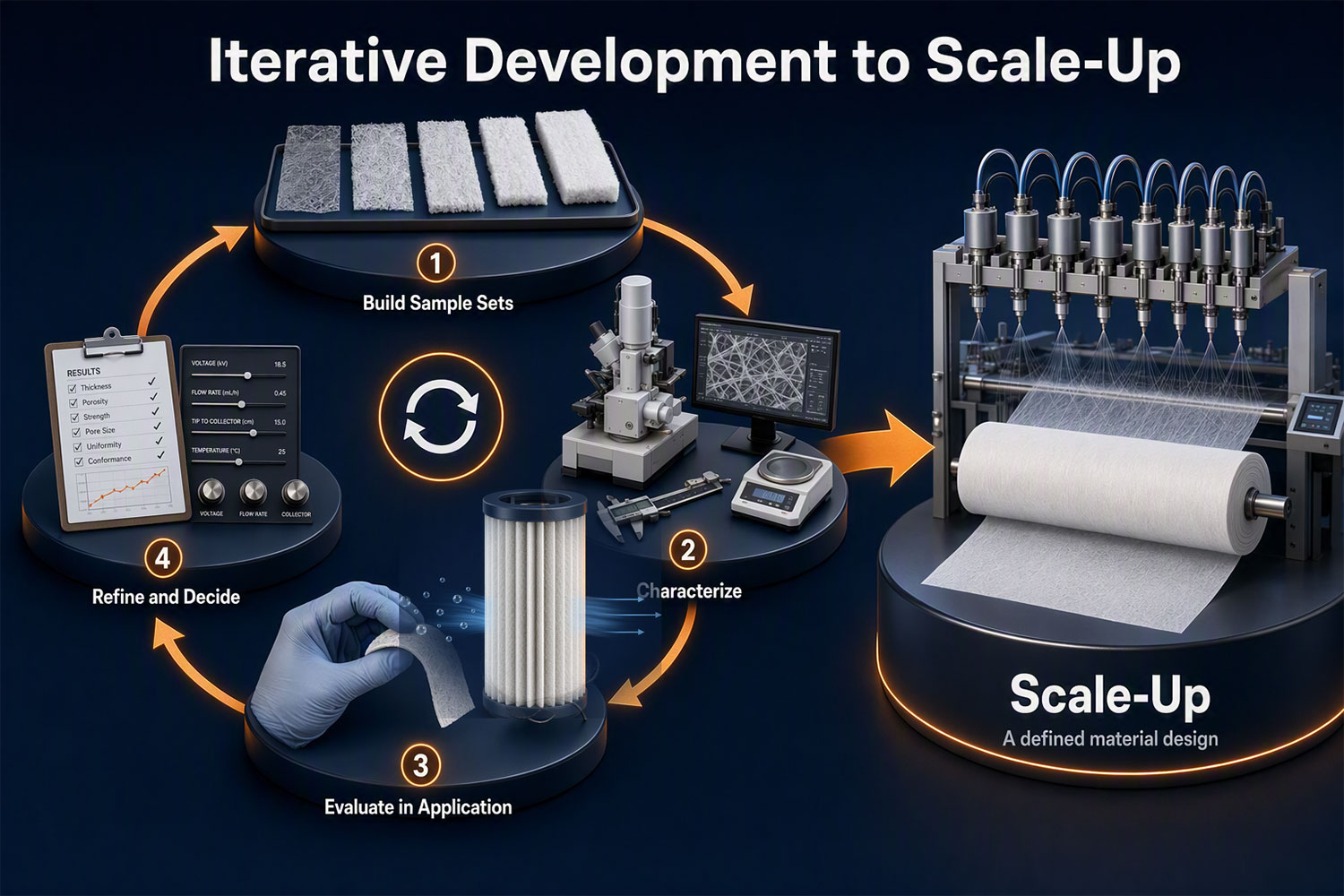
Optimization moves forward by producing samples, evaluating their performance, and using those results to guide the next iteration. Rather than relying on a single “best” condition, we typically build multiple samples that explore a controlled range of material architectures or device configurations.
Analytical testing helps connect process changes to the resulting material. Depending on the product specifications, this may include scanning electron microscopy, fiber-diameter analysis, thickness and basis-weight measurements, mechanical testing, surface characterization, or other application-specific methods. These results show whether the material is moving toward its targets and which variables should be adjusted next.
Laboratory measurements, however, do not always tell the full story. A material may meet its dimensional and morphological specifications but behave differently when incorporated into a device, exposed to a downstream process, or tested under its intended use conditions. Representative samples are therefore provided for customer evaluation throughout development.
This feedback is a critical part of iterative design. Application testing may reveal that one fiber architecture handles better, integrates more effectively, or provides stronger functional performance than another. It may also expose tradeoffs for example, a change that improves handling may alter permeability, flexibility, or device conformance. Those findings are translated into the next sample set so the material can be refined as a complete system.
Each cycle builds on the last: prepare controlled samples, characterize the material, evaluate its performance, and use the findings to define the next development decision. Through this process, fiber diameter, thickness, polymer selection, and form-factor design converge into a material that meets its specifications and performs as intended in the application.
Preparing for Scale-Up
Optimization brings the critical design elements together into a material that works for the application. The polymer formulation, fiber diameter, thickness, basis weight, and product form have been developed as an integrated system and evaluated against the product requirements.
The result is more than a successful sample. It is a defined material design supported by a stable formulation, established process conditions, fit-for-purpose tooling, and performance feedback from representative testing. These are the building blocks needed to move the project toward a commercial material.
With this foundation in place, scale-up can focus on increasing production capacity while maintaining the material architecture and performance established during optimization. The design targets are known, the critical process interactions are better understood, and there is a clear standard against which larger-scale samples can be evaluated.
In the final article of this series, we will explore how that optimized material design is transferred to larger equipment and advanced toward reproducible manufacturing and commercialization.