
From Concept to Construct: Establishing Electrospinning Feasibility
When electrospinning is selected as a potential path for a new material or device concept, the first challenge is determining how to evaluate that opportunity without making a large commitment before the technical foundation is understood.
For many development teams, outsourcing the initial work is the most practical place to begin. Building internal electrospinning capability requires more than purchasing equipment. It also requires formulation knowledge, process-development experience, analytical support, and the infrastructure needed to work safely and consistently with the selected materials. Making those investments before the process has been established can add cost and complexity without reducing the underlying technical uncertainty.
Working with an experienced development partner allows the concept to be evaluated using established expertise and existing infrastructure. This improves the likelihood of identifying viable starting conditions, recognizing limitations early, and generating useful evidence before decisions are made about broader optimization, equipment acquisition, or internal process transfer.
The purpose of feasibility is not simply to show that fibers can be produced. It is to determine whether the selected material can be translated into a construct that is relevant to the intended application, identify the constraints that will shape development, and establish what must be refined before the process can advance.
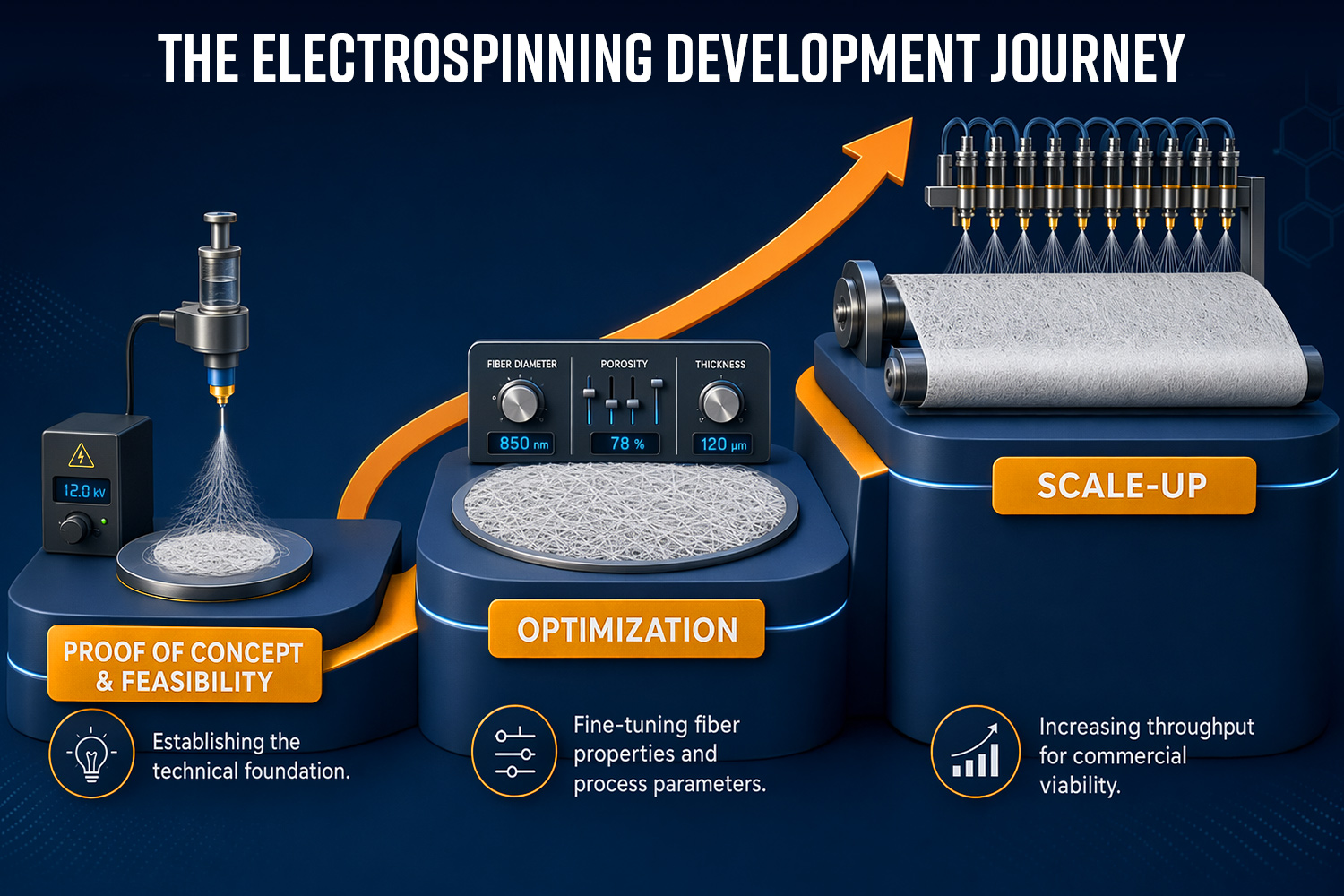
Electrospinning development typically progresses through three stages:
Proof of concept establishes the initial technical foundation. Optimization builds greater control around the properties that matter most, and scale-up translates that process toward larger formats, increased throughput, or commercial viability.
For an initial proof-of-concept project, we focus on three questions:
- What does the material need to accomplish?
- How should feasibility be evaluated?
- What evidence is needed to support the next stage of development?
Defining the Metrics for Success
Every feasibility project begins by defining what success needs to look like for the intended application. The objective is not simply to determine whether a polymer can be electrospun. It is to establish a set of practical criteria that can be used to judge whether the concept is ready to move forward.
Those criteria begin with the intended form of the material. A flat sheet, tubular structure, coated substrate, or three-dimensional device covering each creates different expectations for coverage, uniformity, handling, and conformation. Success may therefore mean producing a continuous sheet that can be removed from the collector, achieving consistent deposition along a tubular construct, or demonstrating that a fibrous layer can conform to and remain associated with a complex device geometry.
Material selection also shapes the feasibility criteria. A polymer may be chosen for its resorption profile, mechanical behavior, prior use, biological compatibility, or ability to meet an established specification. Understanding why the material was selected helps define which properties must be preserved and which may be adjusted during formulation and process development.
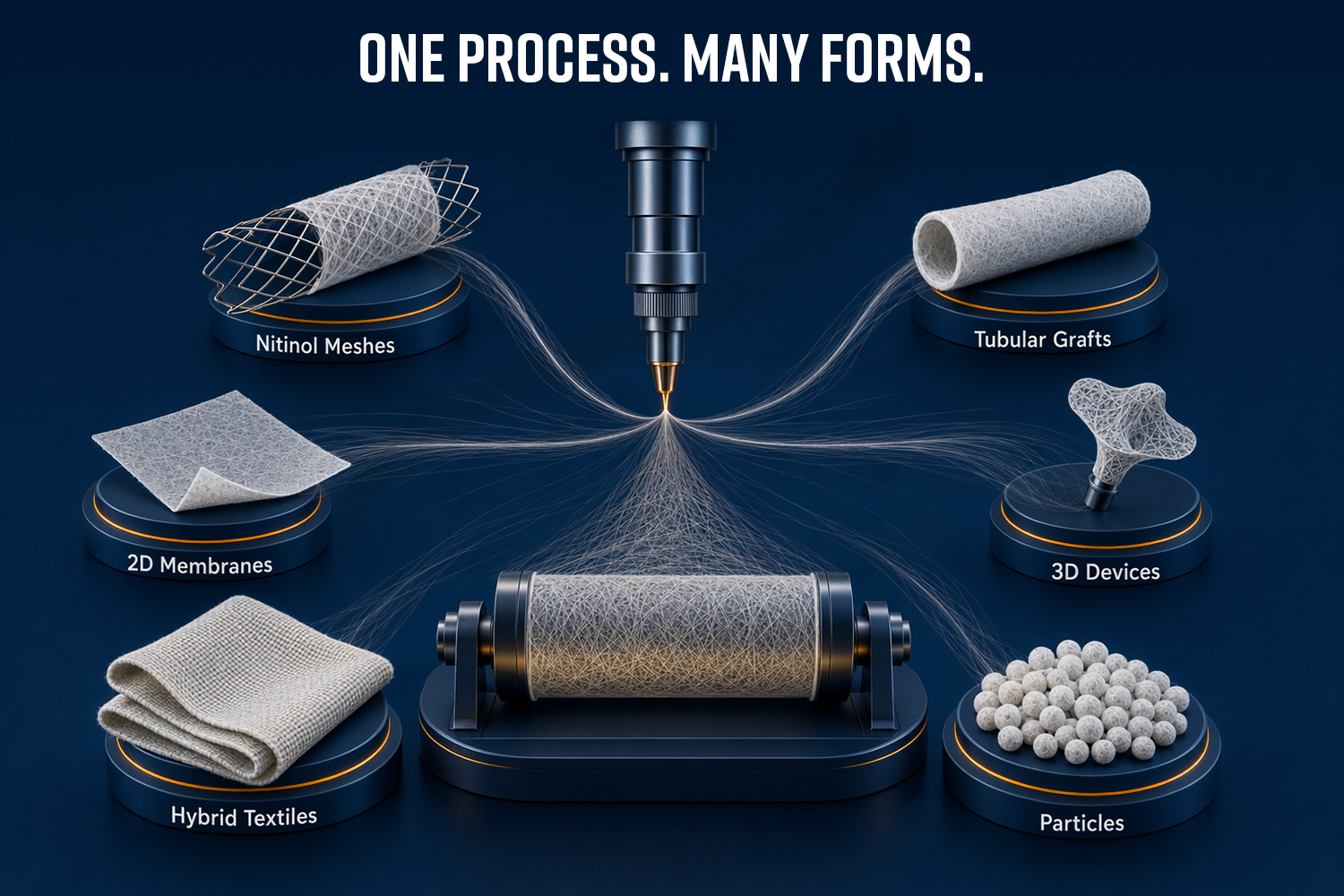
From there, we translate the application into a focused set of material and process metrics. Depending on the project, these may include stable fiber formation, acceptable morphology, a target fiber-diameter range, sufficient thickness, uniform coverage, material integrity during handling, adhesion to an underlying substrate, or successful incorporation of an active component.
Not every metric carries equal weight during feasibility. Some are essential for determining whether the concept is technically viable, while others are better addressed during optimization. Our role is to identify the few criteria that matter most at this stage and use them to guide development.
The result is a clear definition of success: a proof-of-concept construct that meets the primary functional requirements of the application and provides enough evidence to justify the next phase of work.
Building and Evaluating the First Constructs
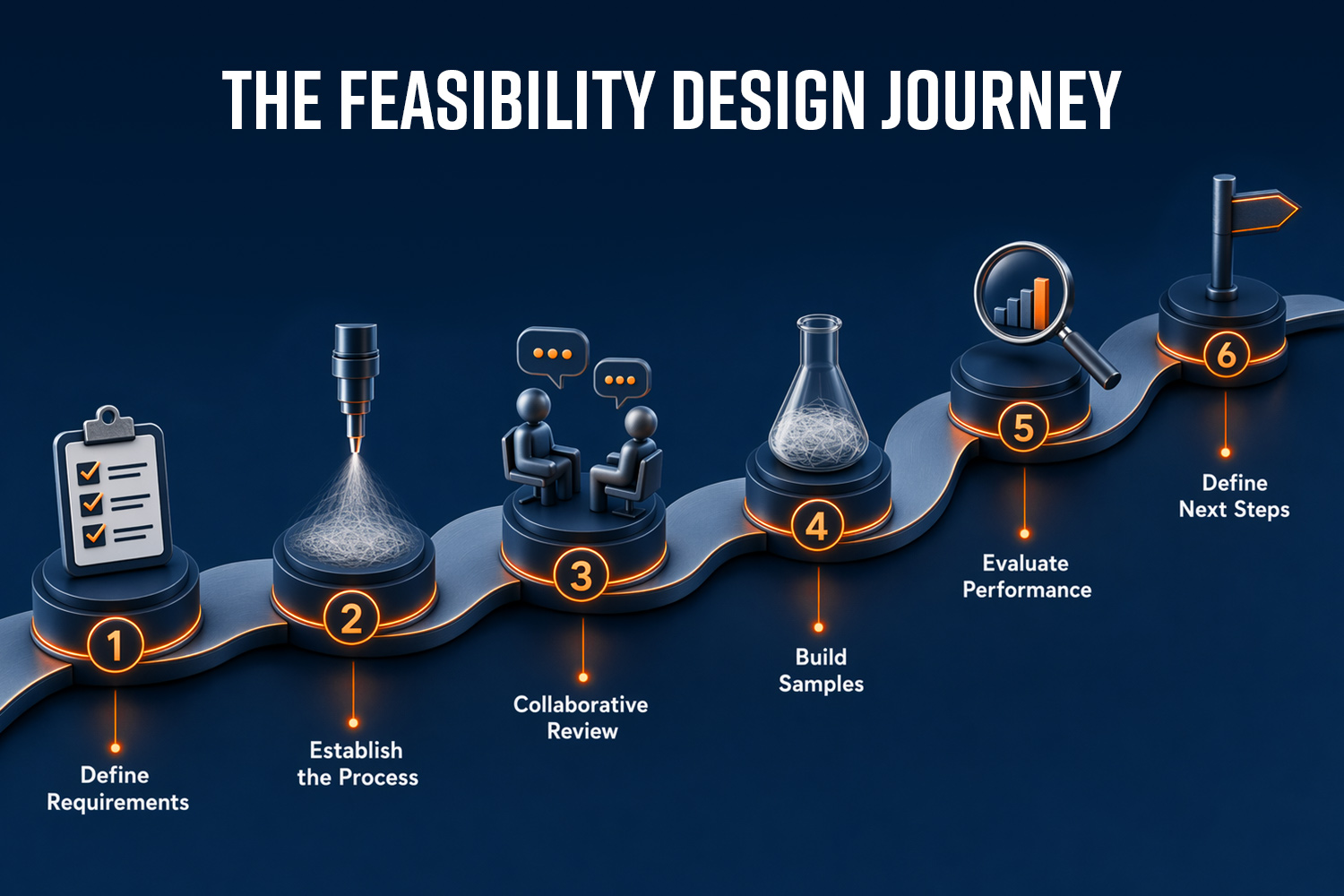
Once the feasibility question is defined, development begins with a focused set of experiments designed to establish a practical starting point. Rather than evaluating every possible variable at once, we use our experience to identify the formulation, process conditions, and collection approach most likely to address the core technical challenge.
The project is structured around technical milestones so that progress can be evaluated as the material develops. Early milestones may focus on confirming solution compatibility, establishing stable fiber formation, or demonstrating successful deposition onto the intended collector or substrate. Later milestones may involve improving fiber morphology, increasing thickness, refining coverage, or producing representative constructs for further evaluation.
This milestone-based structure is intended to keep the project focused while also allowing development to respond to what the material reveals.
Electrospinning projects frequently generate information that cannot be fully predicted before experimental work begins. A preferred polymer may require a different formulation strategy than initially anticipated. A material that performs well on a flat collector may behave differently on a tubular geometry or complex three-dimensional device. A construct may meet the original feasibility objective but reveal that handling, adhesion, thickness uniformity, or another property should become the next development priority. to the implant. They must move, flex, and recover alongside it.
These observations are not treated as deviations from a rigid plan. They become part of the decision making process.
We communicate findings throughout development and use them to guide the next step. This gives our clients visibility into what is working, where limitations are emerging, and why a particular technical adjustment is being recommended. It also creates natural opportunities to review priorities and confirm that the project remains aligned with the intended application.
Collaboration is particularly important when an established method, proprietary device, or specific handling requirement is involved. In these cases, technical discussions, demonstrations, or on-site participation can help us understand practical details that may not be captured fully in a written procedure. Customers may join us during development to explain their process, demonstrate how a device is prepared or handled, or observe how their concept is translated into an electrospinning workflow.
This collaborative approach allows project specific knowledge to be integrated directly into development while our team applies the electrospinning experience needed to evaluate formulation, process behavior, and collection strategy.
The result is a process that is both structured and adaptive. Each milestone is intended to reduce uncertainty, maintain alignment with the application, and move the project toward a construct that is ready for more focused optimization.
Turning Feasibility Results into a Development Path
At the end of feasibility, the most important question is not simply how the material looks under characterization. It is how the construct performs in the context of the intended application.
We provide proof-of-concept materials or devices that can be applied, handled, and evaluated in a way that reflects their intended use. This allows the development team to assess practical factors such as fit, coverage, conformability, handling, integration with the underlying device, and overall suitability for the application.
Characterization remains an important part of the process. Standard offerings such as scanning electron microscopy, thickness measurements, mechanical testing, and other analytical methods help document key material features and provide a baseline for future development. However, these measurements are most valuable when interpreted alongside the functional evaluation of the construct.
The combined outcome is both physical evidence and technical direction: a proof-of-concept device, supporting characterization, a clearer understanding of the remaining limitations, and a defined path into optimization.
Throughout this process, we communicate what has been established, where limitations remain, and how the findings influence the recommended next step. This transparency allows technical results and application-level feedback to be reviewed together, creating a collaborative basis for deciding whether the concept is ready to advance, requires further refinement, or should be reconsidered before additional resources are committed.
Building a Stronger Foundation for Development
Feasibility is most valuable when it does more than show that an electrospun material can be produced. It should connect the material concept to the intended application, identify the technical constraints that matter, and provide enough evidence to guide the next development decision.
Our approach combines electrospinning experience, analytical capabilities, and project-specific development to build that foundation. By structuring the work around clear technical questions, sharing findings as they emerge, and incorporating application level feedback, we help ensure that the outcome is relevant to the broader program rather than limited to a successful laboratory trial.
The result is a proof-of-concept construct supported by a clearer understanding of the material, the process, and the path forward. That foundation allows optimization to begin with defined priorities and creates a more informed route toward eventual scale-up.