
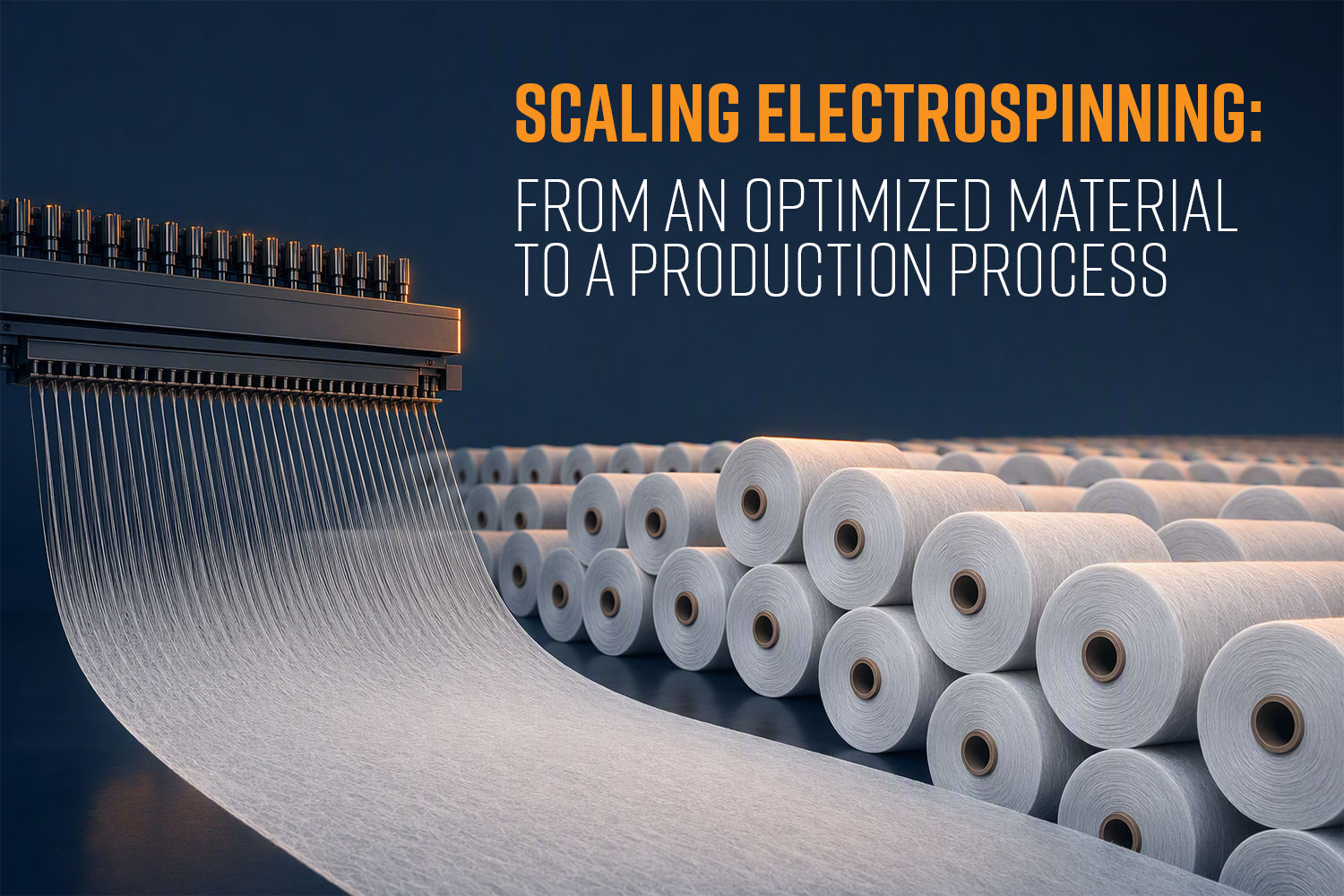
By the time an electrospinning process reaches scale-up, we already know how to make the material. Feasibility established that the formulation could be electrospun. Optimization refined the process until the fiber morphology, thickness, basis weight, and other critical properties were where we wanted them. But anyone who has worked in manufacturing knows that bench scale is not commercial scale.
A process that behaves beautifully with a small batch of solution, a single needle, and a short production run can look very different once the batch volume increases, the run lasts for hours, and one emitter becomes 20, 40, or more than 100. The formulation may be the same, but the process around it has changed. Collectors get larger. More solution has to be prepared and delivered consistently. Mixing methods may need to change. Electric fields begin to interact across multi-needle arrays. And the increased fiber output has to be distributed evenly enough to maintain the same material properties over a much larger production area.
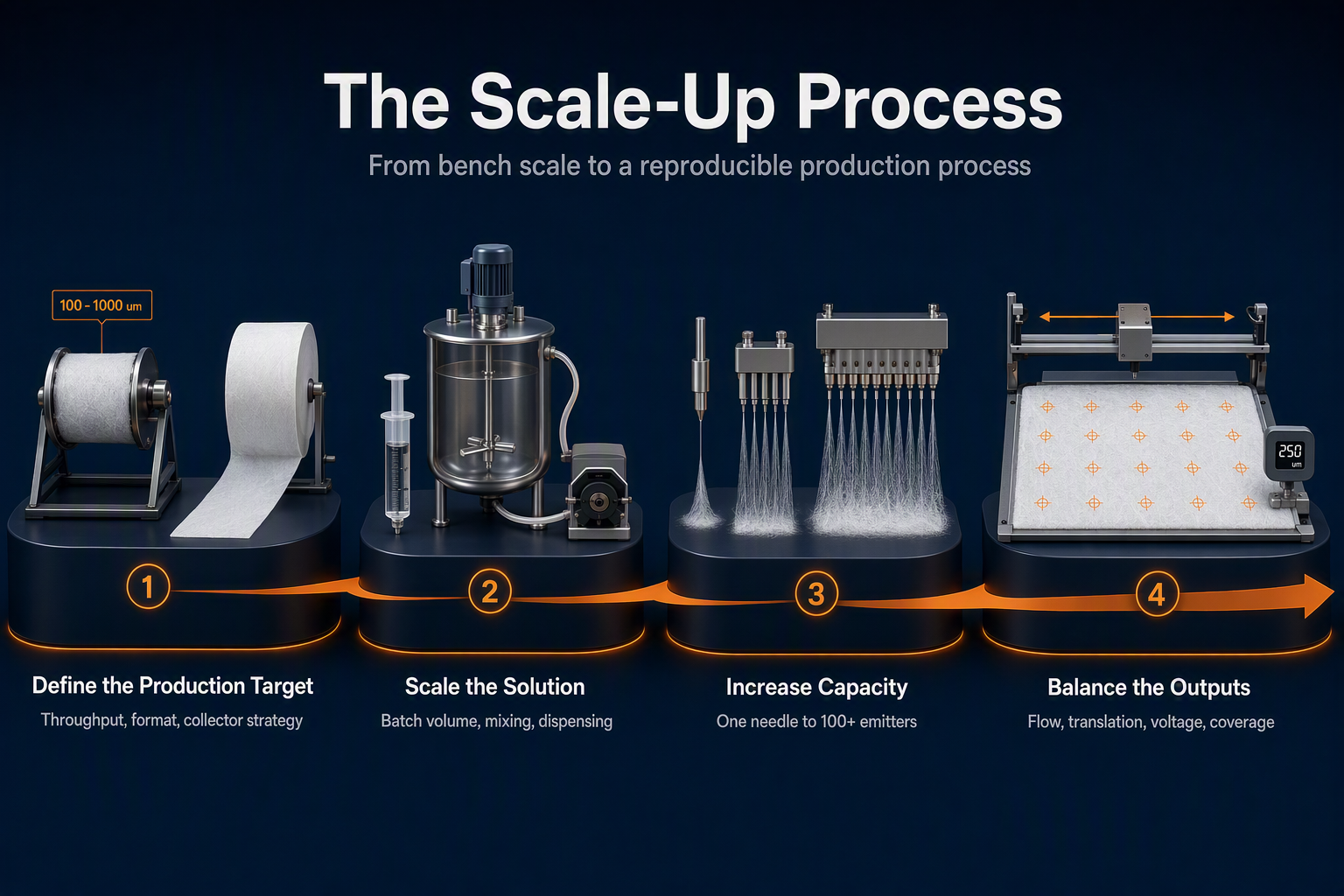
That is the real work of scale-up. The goal is not simply to make more fibers. It is to preserve the material developed during. Moving from bench scale to production means answering four practical questions:
- What are we trying to produce? Define the required throughput, product format, collector strategy, and level of control needed.
- How do we scale the solution? Increase batch volume, mixing capability, and dispensing capacity while maintaining solution quality throughout longer production runs.
- How do we increase production capacity? Translate the optimized single-needle condition into increasingly larger multi-needle arrays, potentially reaching 100+ emitters.
- How do we keep the material uniform? Balance flow rate, needle translation, collector movement, voltage, and deposition area so that increased throughput still produces a homogeneous mat.
These decisions bring the optimized material out of the bench-scale environment and begin turning it into a reproducible production process.
Define the Production Target
Scale-up starts by defining what the process needs to produce. How much material is required? What size and thickness are needed? How quickly does it need to be made? And how tightly do thickness and fiber properties need to be controlled?
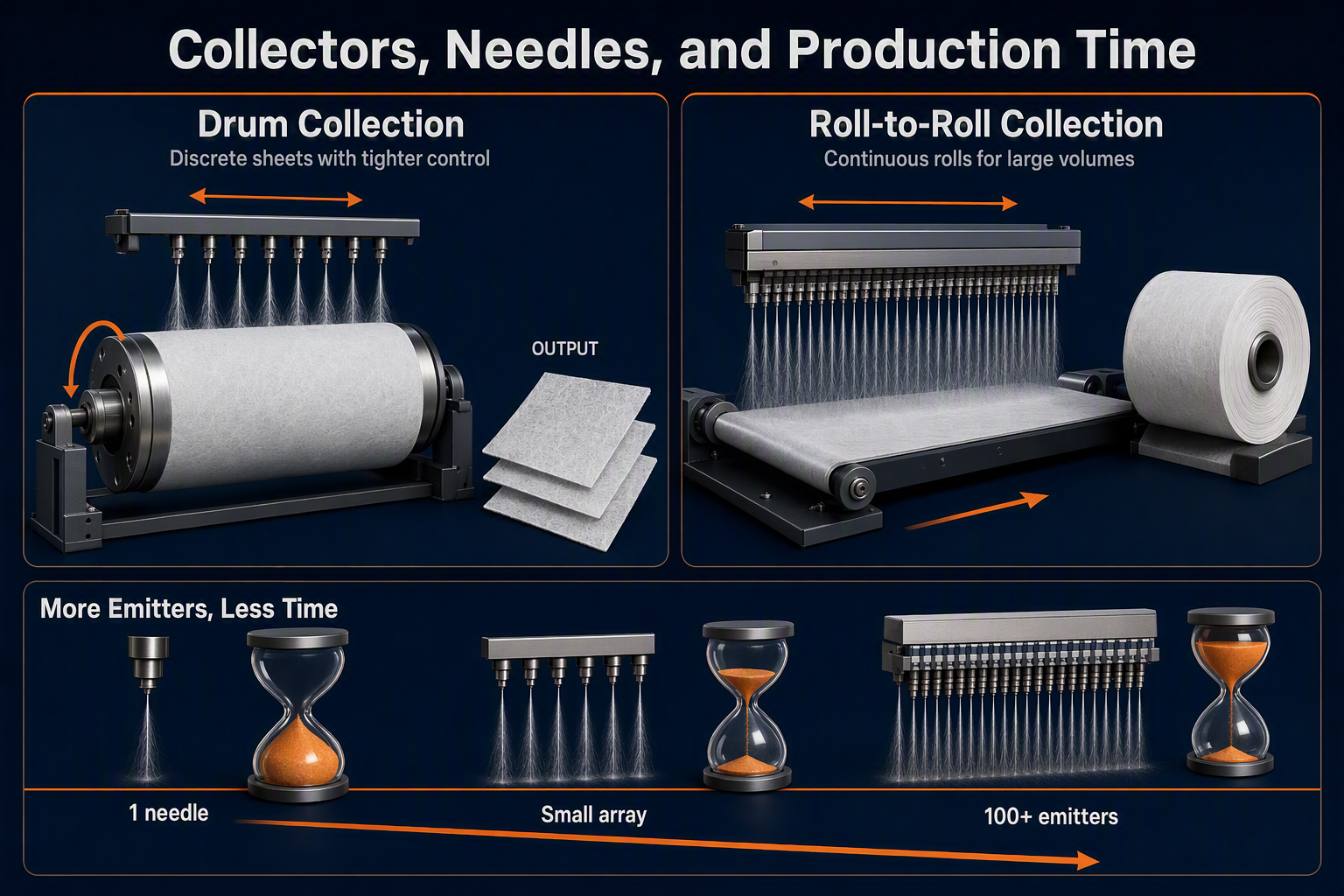
A rotating drum is often well suited for batch production where tighter control is important. For example, a one-hour production run may generate a mat roughly 100–1000 µm thick, depending on total flow rate and collection conditions. Because the deposition area is defined, drum collection can provide good control over thickness, deposition uniformity, and fiber-size distribution. That makes batch production attractive for applications where each mat needs to remain within a relatively tight specification window.
Roll-to-roll collection serves a different need. It is better suited to continuous production environments where the process may run for hours and very large volumes of material are required. Filtration media is a good example: the priority is often producing large areas of material efficiently and continuously rather than manufacturing one highly controlled discrete mat at a time.
The production target therefore helps guide collector choice, needle count, flow rate, pump capacity, and solution volume. Scale-up is not simply about producing more fiber. It is about choosing the configuration that produces the right material at the right rate.
As needle count and production time increase, the solution itself has to scale with the equipment. A small feasibility run may only require a few milliliters of material delivered from a syringe. A 100+ needle array running for hours is a very different problem. Suddenly, we have to think about how much solution is needed for the full run, how it will be mixed, how it will be delivered to every emitter, and whether its properties will remain consistent from the beginning of production to the end.
We start by translating the expected production rate into solution demand. That tells us the required batch volume and helps determine whether a syringe-based dispensing system is still practical or whether a larger-volume pumping strategy is needed.
Syringe pumps provide precise control and are extremely useful during development, but they become less practical as solution demand increases. Larger-scale systems may move toward peristaltic pumping or reservoir-based delivery, reducing the need for repeated syringe changes and allowing much longer uninterrupted runs.
Changing the pump, however, also changes how the solution reaches the needle tips. Flow has to remain consistent across the array. Tubing length, pressure, pump behavior, and distribution between emitters all become part of the dispensing strategy. The objective is not simply to supply enough solution, it is to make sure each needle receives material consistently enough to maintain the stable Taylor cones and fiber formation established during optimization.
Batch preparation changes as well. A solution that was originally prepared with a stir bar may require an overhead mixer once the batch volume increases. We evaluate whether the larger mixing process is still producing a solution with the same characteristics rather than assuming that an unchanged formulation will automatically behave the same at a larger scale.
This is where the solution-characterization work completed earlier in development becomes especially valuable. Viscosity, conductivity, surface tension, and other relevant quality metrics give us a way to compare the larger production batch to the solution that produced the optimized fibers. They also allow us to monitor what happens during longer runs.
A production solution may now remain in a reservoir, tubing, or mixing vessel for several hours. We want to understand whether its properties remain stable over that entire period. If viscosity begins to increase, solvent is being lost, or another quality metric starts to drift, the fibers being produced several hours into the run may no longer be equivalent to those produced at the beginning.
For longer production runs, solution quality therefore becomes something we monitor over time rather than something we measure only before electrospinning begins. The objective is to preserve the same solution arriving at every needle tip from the first few minutes of production through the final hours of the run. Scaling the solution, mixing, pumping, and dispensing system together is what allows the larger electrospinning process to remain anchored to the material developed during optimization.
Increase Production Capacity Iteratively
The path from a single needle to a 100+ needle array is built in stages.
We begin with the optimized single-needle condition because that gives us the reference point for everything that follows. The solution should already be stable, the Taylor cone consistent, and the fiber morphology repeatable. If the process is marginal at one needle, adding more emitters will only make those instabilities harder to manage. From there, we begin increasing needle capacity incrementally.
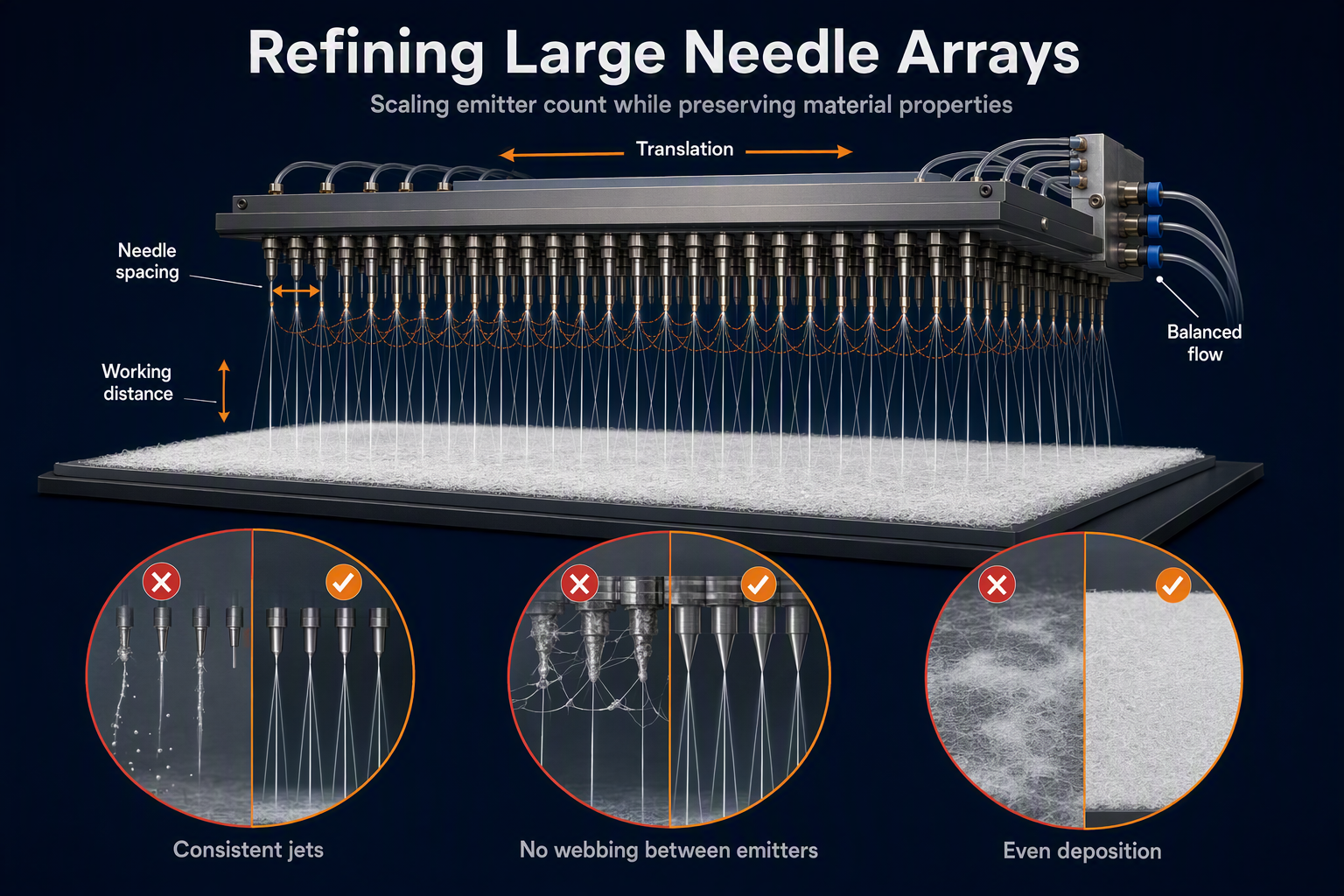
At each step, we ask the same questions: Are all of the emitters spinning consistently? Has the fiber morphology changed? Is the deposition pattern still uniform? Are we seeing more webbing, localized buildup, or changes in where the fibers are collecting? Those observations tell us what needs to be adjusted before we move to the next level.
As the array grows, voltage requirements may shift. Flow rate may need to be rebalanced across the emitters. Working distance, needle spacing, and collector movement may also need to change as the electric fields begin interacting and more material reaches the collector.
The process becomes a cycle of increase, evaluate, adjust, and advance. For example, if adding another group of needles increases deposition in one region of the collector, translation may need to change to redistribute the material. If the jets begin interacting or webbing between emitters, voltage, spacing, or working distance may need to be adjusted before adding additional capacity.
This iterative approach allows the process to grow while preserving the material properties established during optimization. The goal is not to jump from one needle to 100. It is to build a stable production system one controlled increase at a time.
Once the needle array is running consistently, we shift our attention from generating more fiber to controlling how that fiber builds into the final mat. Our approach is to start with the target material properties, then work backward through the variables that control deposition.
For a rotating drum, we can use time as part of the process. The needles translate along the y-axis while the drum rotates beneath them, allowing the mat to build gradually with each pass. We adjust flow rate, translation speed, drum speed, and voltage while monitoring how evenly the material accumulates across the collector. If the mat has not yet reached the target thickness or basis weight, we can continue the run until it does. That flexibility makes drum-based scale-up well suited to applications where tighter control over the final mat is important.
Roll-to-roll requires a different strategy. Here, the needles again translate along the y-axis, but the collector continuously advances along the x-axis beneath the multi-needle array. We first define the target thickness or basis weight and the desired web speed, then determine how much material must be deposited while each section of the collector is inside the active deposition zone. From there, we balance total flow rate, needle translation, voltage, and collector speed until the material is being deposited evenly across both the width and length of the web.
This balance is especially important because there is very little opportunity for correction once the material moves beyond the collection area. If one region receives too little fiber, that section remains thin. If too much material is concentrated in one area, the result is a local thickness increase. If voltage does not provide sufficient attraction across the full collector width, fibers can drift away from the intended deposition zone and create uneven coverage.
We therefore build the condition iteratively. We run the system, map where the material is depositing, measure thickness and basis weight across the collection area, and adjust the process based on what the mat is telling us. The goal is to reach the point where needle output, collector movement, and fiber attraction are balanced well enough that the desired material properties are produced consistently across the full usable area.
Bringing the Process Together
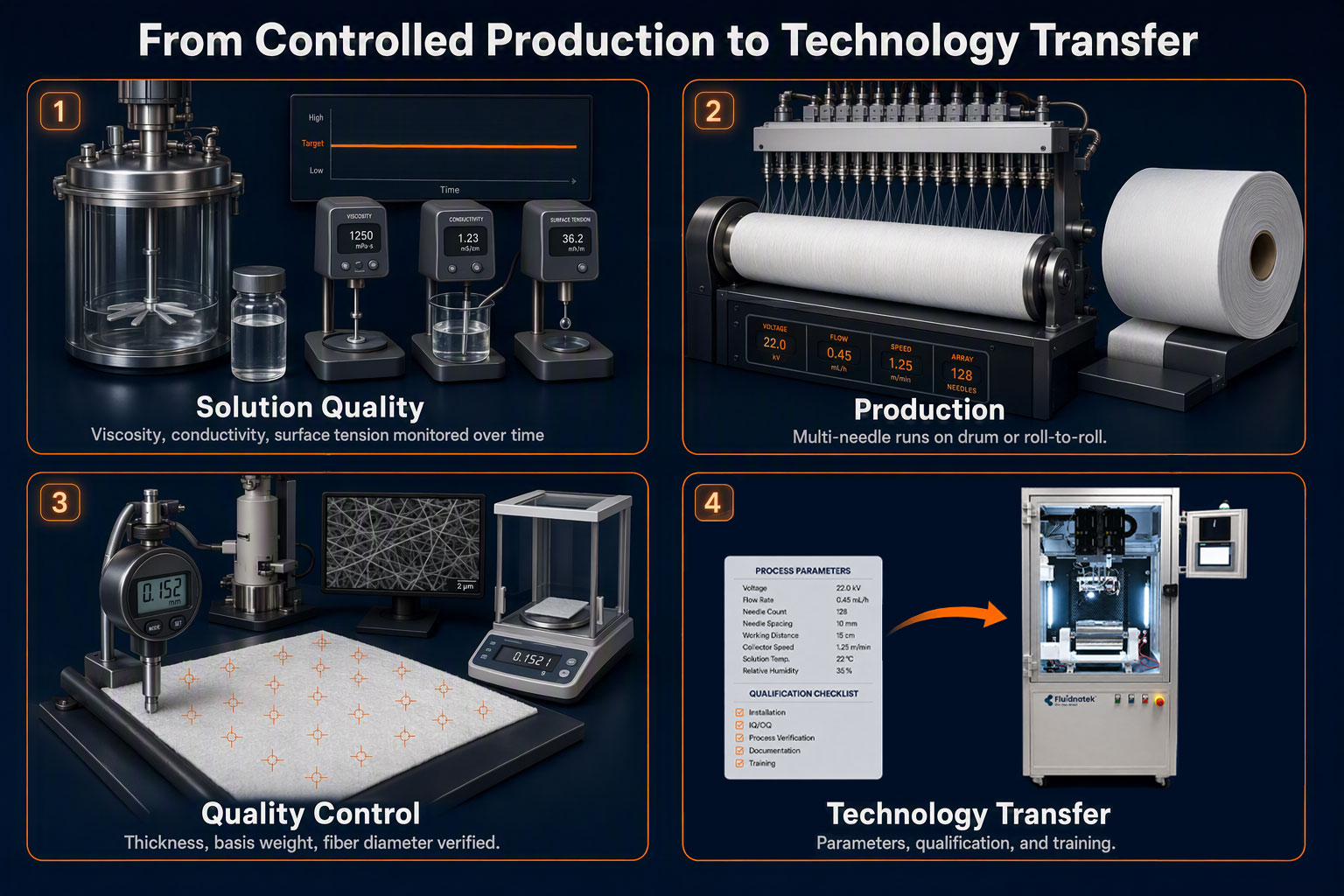
Successful scale-up is the point where the individual pieces of development become one coordinated production process. The collector configuration, needle capacity, flow rate, translation strategy, voltage, solution preparation, pumping system, and run time all have to work together to produce the same material repeatedly and within the required specification window.
At that stage, the goal is no longer simply to demonstrate that the material can be made. The process has to reliably produce the required thickness, coverage, fiber distribution, and overall mat quality at the throughput needed for the final application. This is where scale-up becomes a bridge to manufacturing.
We can help define that process from the early production targets through multi-needle development, collector selection, solution handling, and final operating conditions. Just as importantly, the process does not have to remain in our facility.
Once the production window has been established, we can support technology transfer into your own electrospinning system. That may include defining equipment requirements, transferring process parameters and solution-preparation methods, supporting installation and qualification activities, and training your team on the operating conditions and controls developed during scale-up.
For companies that want to build internal manufacturing capability, the objective is not simply to hand over a set of parameters. It is to transfer the understanding behind the process so that your team can operate, troubleshoot, and continue developing it with confidence. Whether the final pathway is continued contract production, technology transfer, or the development of an internal manufacturing process, scale-up is ultimately about creating a system capable of delivering the finished product consistently.