
Outsourcing research and development to a contract research organization (CRO) provides access to specialized expertise, equipment, and technical capabilities that can accelerate the development of new materials and products. For emerging technologies such as electrospinning, this approach allows companies to advance their innovations without making significant investments in specialized infrastructure or developing an entire technical team internally. As a product progresses toward commercialization, an important question emerges: What happens when the development work is complete and you are ready to take control of manufacturing?
This question represents one of the most significant considerations when choosing an external development partner. A successful R&D program may deliver an electrospun material that meets every target specification, but that does not necessarily mean the customer has the capability to reproduce it. The formulation, processing conditions, equipment configuration, and technical understanding required to manufacture that material may still reside with the organization that developed it. Without a pathway to transfer that knowledge, customers can find themselves dependent on their development partner for continued sample production, process modifications, and future manufacturing activities.
As products transition into manufacturing, companies face important decisions about production capacity, equipment investment, and whether to manufacture internally or through an external partner. Each pathway introduces technical and financial risks, particularly when the ability to reproduce the desired material has not been demonstrated on the intended production equipment. A process that performs successfully during laboratory development may behave differently when implemented on another system, potentially requiring additional optimization before reliable production can begin.
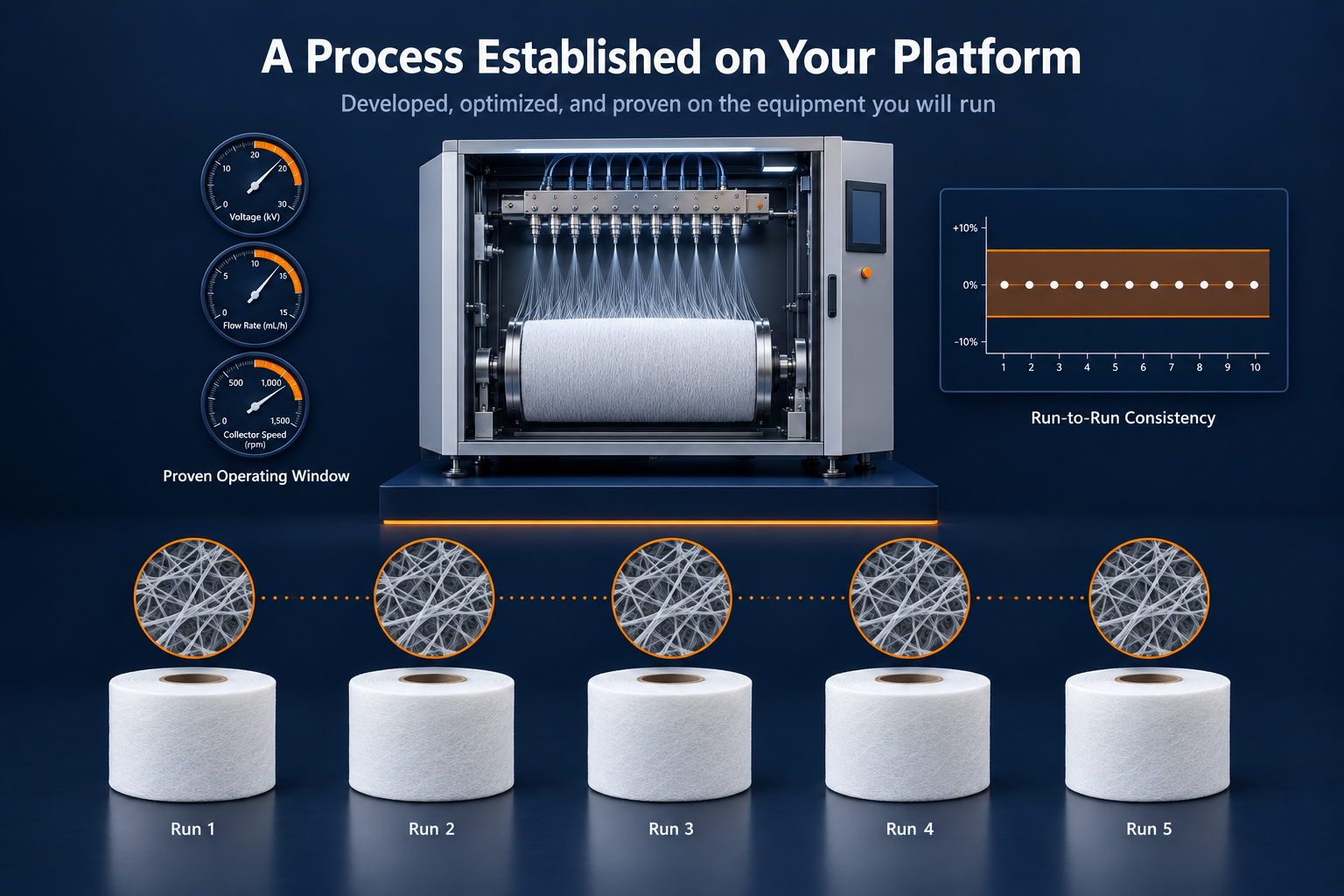
Technology transfer provides an opportunity to address these uncertainties before committing to manufacturing. By establishing and demonstrating an electrospinning process on the intended equipment platform, the compatibility between the process, equipment, and product specifications can be evaluated in advance. Combined with defined operating procedures, quality control methods, and technical training, this approach provides a structured pathway from development to production while giving customers greater flexibility and control over their manufacturing decisions.
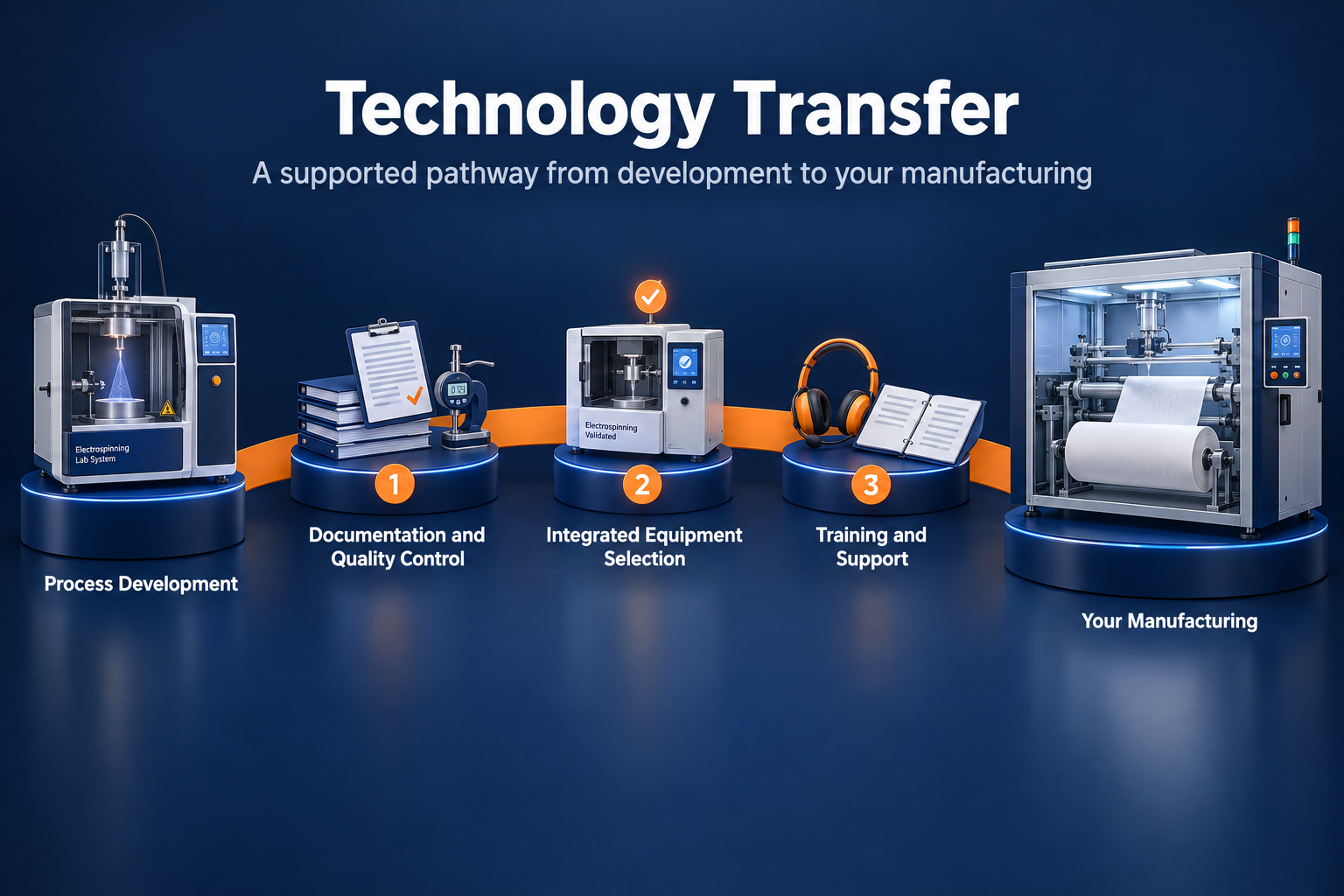
For electrospinning processes, this transition is supported through three key elements:
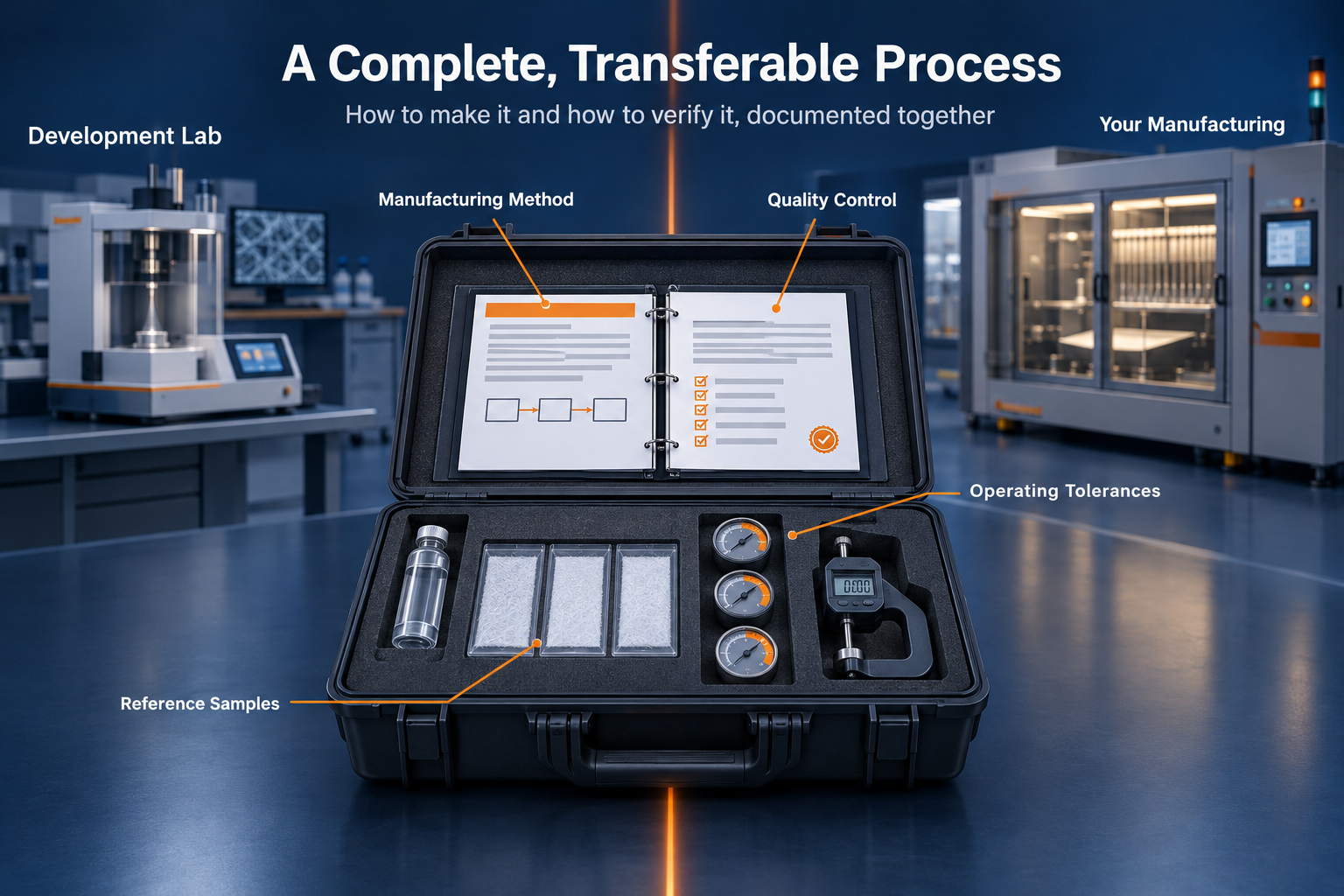
- Process Documentation and Quality Control: Establishing a defined manufacturing methodology that includes polymer formulation and preparation, equipment configurations, critical processing parameters and operating tolerances, and collection procedures. This is paired with analytical methods and acceptance criteria to ensure the transferred process produces material that meets the intended product specifications.
- Integrated Equipment Selection and Manufacturing Implementation: Combining CRO process development with electrospinning instrument sales to deliver a turnkey solution. Customers can demonstrate their process on the intended equipment before purchase, reducing investment risk and enabling a more direct transition to production. .
- Training and Continued Technical Support: Providing the practical knowledge and technical guidance necessary to implement the transferred process, troubleshoot initial production challenges, and support future process optimization or product iterations.
Process Documentation and Quality Control
A successful electrospinning development program establishes the formulation, operating conditions, and equipment configuration necessary to produce a material with the desired characteristics. When transferring that process to a manufacturing environment, this knowledge must be translated into clear, actionable instructions that another technical team can implement. The resulting documentation provides a defined methodology for reproducing the material, from raw material selection and polymer solution preparation through equipment setup, electrospinning, collection, and any necessary post-processing.
Central to this methodology is identifying the critical process parameters and their acceptable operating tolerances. Electrospinning is particularly sensitive to variations in solution properties, environmental conditions, and equipment settings, all of which can influence fiber formation and the resulting material characteristics. Defining these parameters establishes the operating boundaries needed to maintain consistency while providing manufacturers with a practical framework for managing process variability.
Just as important as defining how the material is produced is establishing how its quality will be evaluated. Analytical characterization connects the manufacturing process to measurable product attributes such as fiber diameter distribution, morphology, membrane thickness, basis weight, pore characteristics, and mechanical properties. By incorporating relevant analytical methods, sampling requirements, and acceptance criteria into the transfer documentation, manufacturers can verify that the resulting material meets its intended specifications rather than relying solely on the replication of equipment settings.
Together, these manufacturing instructions and quality control procedures provide the foundation for integrating the established process into the receiving organization’s operations. Whether intended for routine sample production or a more controlled manufacturing environment, the documentation can be adapted to the customer’s production requirements and existing quality management system. The result is a transferable process that defines not only how to manufacture the material, but also how to evaluate its consistency and maintain control over product quality.
Equipment Selection and Manufacturing Integration
The combination of contract research and development services with electrospinning instrument sales creates a unique opportunity to bridge the gap between process development and manufacturing. Rather than treating equipment selection and process development as separate activities, these capabilities can be integrated to provide customers with a coordinated pathway from an established material formulation to an operational production system. This approach allows equipment decisions to be guided by demonstrated process performance and the specific manufacturing requirements of the customer’s product.
Selecting electrospinning equipment involves more than evaluating production capacity, process controls, and technical specifications. A system must be capable of producing the desired material at the required scale while maintaining the critical characteristics established during development. By bringing process development scientists and instrument specialists together, formulation requirements, solution delivery, collection configurations, and production throughput can be evaluated against the capabilities of available equipment platforms.
More importantly, the customer’s electrospinning process can be developed, optimized, and demonstrated on the equipment platform they are considering for purchase. This provides an opportunity to evaluate equipment suitability using the customer’s actual material and product specifications rather than relying solely on general equipment capabilities. With the process and equipment evaluated together, customers can move toward purchasing a system with an established operating methodology instead of acquiring equipment and subsequently undertaking a separate process development effort.
This integration creates the foundation for a turnkey electrospinning solution. The established process can be transferred alongside the selected equipment, supported by defined operating procedures, material specifications, operator training, and technical guidance. Rather than navigating equipment procurement, process development, and manufacturing implementation as independent challenges, customers benefit from a coordinated approach that reduces uncertainty and supports a more efficient transition into production.
For organizations pursuing outsourced manufacturing, the same process knowledge provides a technical foundation for evaluating manufacturing partners and transferring production requirements. Whether the ultimate objective is internal production or contract manufacturing, the ability to connect process development with equipment capabilities provides greater flexibility and control over manufacturing decisions.
By integrating CRO expertise with instrument sales and technical support, technology transfer becomes more than a handoff of processing instructions. It provides a direct pathway to an electrospinning manufacturing capability developed around the customer’s specific product.
Training and Continued Technical Support
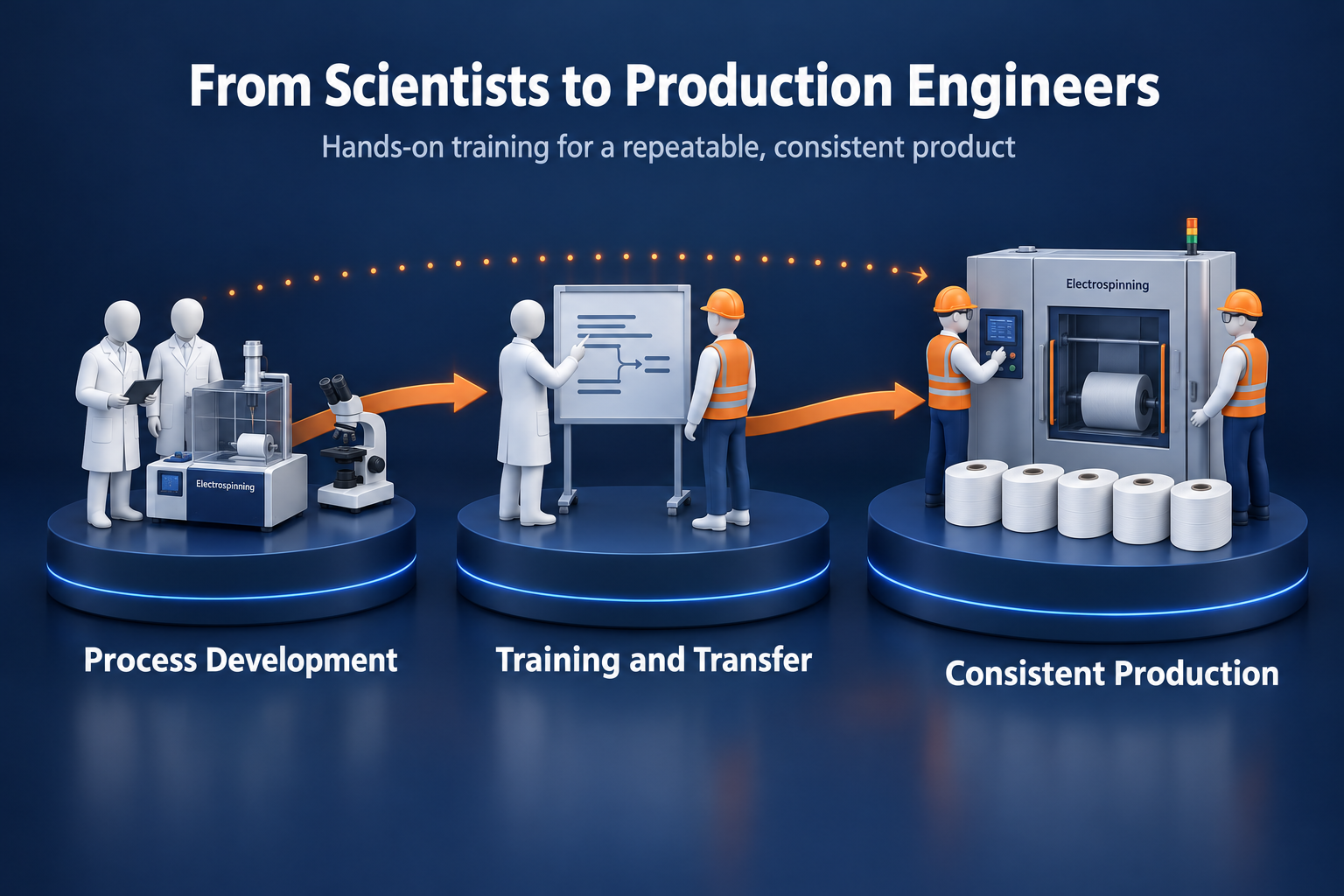
Technology transfer extends beyond process documentation to include the training and technical support necessary for successful implementation. Working directly with the receiving team, training can address equipment setup, solution preparation, process operation, material collection, and quality assessment. This hands-on knowledge transfer helps operators understand critical processing parameters, recognize deviations, and confidently reproduce the established manufacturing methodology.
As the process is implemented within the receiving manufacturing environment, continued technical support provides a resource for troubleshooting, evaluating process performance, and addressing challenges that may arise during initial production. This collaboration can extend beyond the initial transfer to support process optimization, changing production requirements, and future product iterations.
The goal is to provide a supported transition from process development to independent manufacturing, giving customers control over their production while maintaining access to technical expertise as their needs evolve.
De-Risking the Transition from Development to Manufacturing
The transition from product development to manufacturing represents a significant investment, both in equipment and the resources required to establish reliable production. Moving forward without a demonstrated process introduces uncertainty around equipment suitability, product consistency, and the time required to achieve operational readiness. These risks can translate into costly development delays, additional process optimization, and unexpected manufacturing challenges.
By establishing and demonstrating the electrospinning process on the intended equipment platform before technology transfer, customers can make manufacturing decisions with greater confidence. The combination of defined processing parameters, verified material characteristics, and documented operating procedures provides a technical foundation for implementation while reducing the uncertainty associated with bringing a new manufacturing capability online.
Technology transfer transforms an established development process into a practical pathway toward production. Whether customers choose to manufacture internally or through an external partner, they gain the flexibility to control how their products are produced without starting development over. By connecting process development, equipment evaluation, and manufacturing implementation, technology transfer helps reduce technical risk, accelerate the transition to production, and preserve the value of the investment already made in product development.